
Quick answer
- What it is
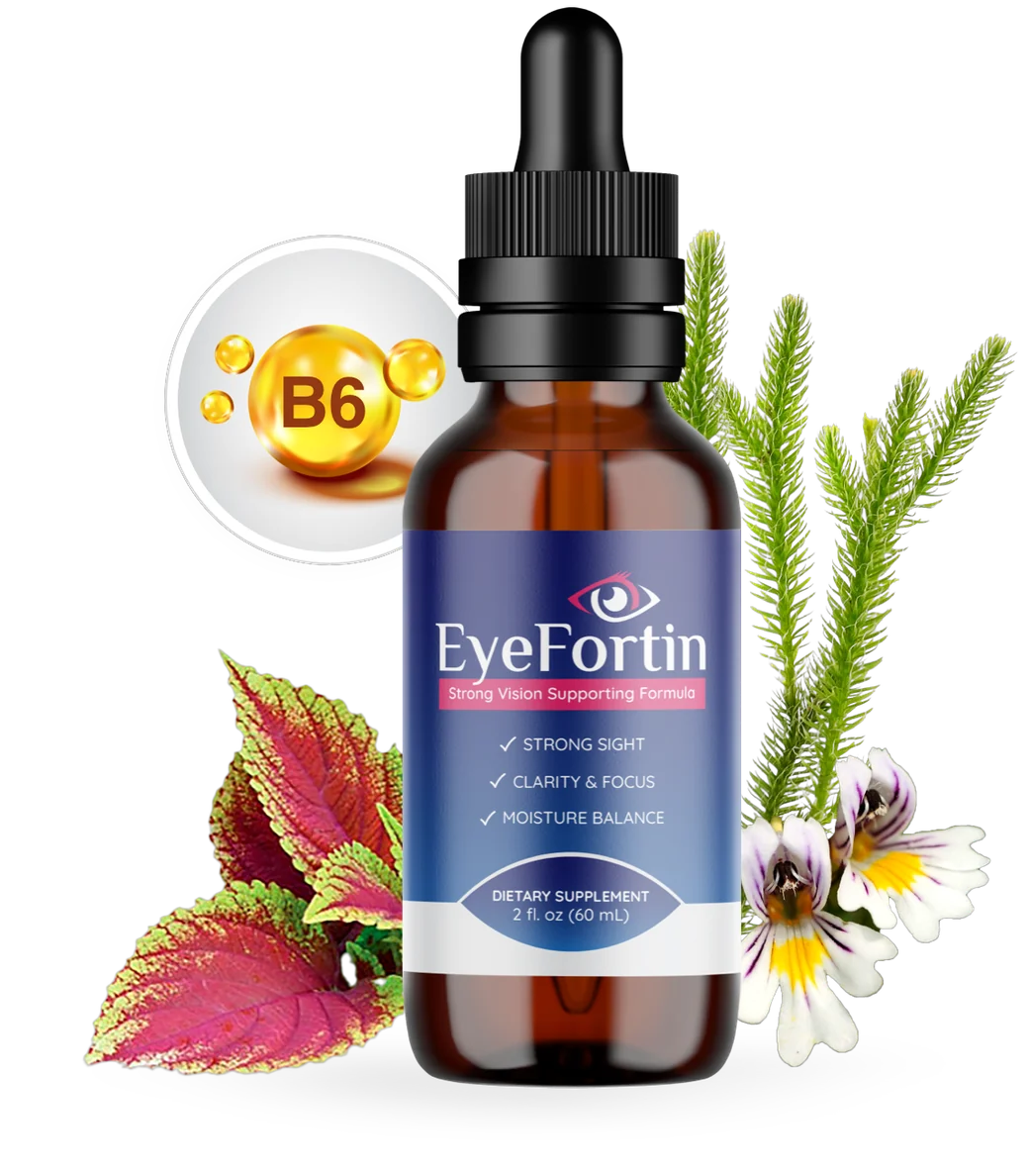
- A liquid dietary supplement — 10 ingredients in a 2 fl oz (60 mL) dropper bottle — marketed for vision support, visual clarity and eye moisture.
- Who distributes it
- The label lists EyeFortin, Tallmadge, Ohio 44278, United States, with contact@eyefortin-product.com as support contact.
- What it claims
- That its compounds rebuild glutamate receptors involved in turning light signals into images, improving clarity and focus.
- What the label discloses
- Niacin 16 mg and vitamin B6 2.5 mg with full doses; eight botanicals and amino acids inside a 500 mg proprietary blend with no individual doses.
- How it is taken
- Two full droppers (2 mL) once daily, preferably in the morning. Each bottle lasts 30 days.
- Price
- $69 for one bottle, $177 for three ($59 each), $294 for six ($49 each). Free US shipping on all three.
- Refunds
- 60-day money-back guarantee stated by the vendor, one-time purchase with no autoship.
- Where it is sold
- Direct only, through the vendor’s own checkout. No verified Amazon, Walmart or pharmacy listing.
The short verdict on EyeFortin
3.4out of 5 — our editorial assessment
EyeFortin is a real, label-disclosed supplement with a plausible nutritional rationale and one significant problem: nobody has tested the finished formula. Every ingredient on the panel has some connection — often a tentative one — to retinal biology, nerve signalling or antioxidant defence. That is not the same as proof that two droppers a day sharpen anyone’s eyesight.
The label itself says it plainly: “The safety of this product has not been determined.” That sentence is unusual in this category and deserves credit for honesty. It also sets the ceiling on what a careful reader should expect.
Our score reflects three things we could verify — a fully named ingredient list, a written 60-day refund window, and free US shipping — against three we could not: measured ingredient doses, a product-level trial, and any independent quality certificate. Read it as “worth understanding, with realistic expectations”, not as “buy this and see better”.
What EyeFortin is
EyeFortin is a liquid dietary supplement taken by mouth, sold in a 60 mL amber dropper bottle, positioned around vision support rather than general wellness. It is not an eye drop, not a prescription, and not a medical device. The liquid is swallowed — straight into the mouth or stirred into a drink — which matters because a surprising number of people assume from the packaging that it goes into the eye.
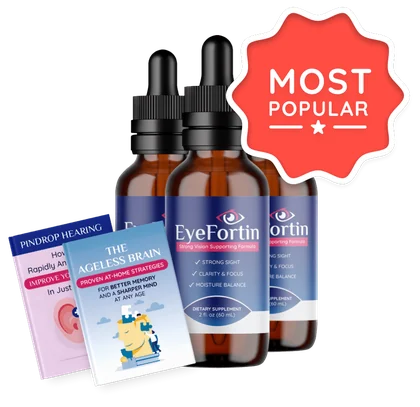
Three labels on the bottle carry the marketing position: “Strong Vision Supporting Formula”, “Strong Sight”, “Clarity & Focus”, “Moisture Balance”. Those are the vendor’s framings, and each one implies a different mechanism — sharpness, neural processing speed, tear-film hydration. In practice the formula contains nothing specifically designed to lubricate the eye surface, so the “moisture balance” line is the weakest of the three (more on this in limitations).
The product sits in a crowded, loosely regulated category that also includes lutein and zeaxanthin capsules, bilberry extracts, AREDS-style multivitamin formulas and omega-3 softgels. What distinguishes this one is format and story: a flavoured liquid with a neurotransmitter narrative instead of a carotenoid one. Whether that story is an advance or a marketing angle is the central question of this review.
Who makes and distributes EyeFortin
The bottle names a distributor, not a manufacturer, and no formulator or research team is credited anywhere. The panel reads: “Distributed By: EyeFortin, Tallmadge, Ohio 44278, United States”, with a support address at contact@eyefortin-product.com. That is the only corporate identity disclosed on the product itself.
This is routine in the direct-response supplement industry, where a brand owner contracts a contract manufacturer and the finished goods ship from a fulfilment warehouse. It is not automatically a red flag. But it does mean three things a reader cannot confirm from public sources: who physically made the liquid, which facility it came from, and whether that facility holds the GMP registration that affiliate pages so often assert. Claims that the product is made in an “FDA-approved facility” circulate widely online; the FDA does not approve dietary supplement facilities, it registers and inspects them. Treat the phrase as marketing shorthand until a registration number is published.
Our editorial position: we contacted the support address listed on the label for this review and will publish the response, unedited, if one arrives. Nothing in this article depends on that reply.
The EyeFortin claims, in the vendor’s own words
The central claim is neurological, not nutritional. The sales page argues that modern life — less natural light, more artificial light — damages glutamate receptors in the brain, that those receptors convert eye signals into images, and that compounds in EyeFortin “can rebuild those receptors”.
“According to new scientific data, the fact that we spend less time in natural light, and more time surrounded by artificial light, damages the glutamate receptors in the brain… The special compounds inside EyeFortin can rebuild those receptors, helping you see every detail of the world again.”
Alongside that, the marketing refers to a “Greek morning ritual”, to an “ultra absorbable dropper”, and to a customer base of more than 107,100 people. We deal with the Greek framing separately in our fact-check of the Greek morning ritual claim; here is the short version: no such ritual appears in the peer-reviewed literature, and the story functions as a hook rather than a citation.
The mechanism claim deserves more attention, and we take it apart below. Two sentences are worth flagging now. First, “glutamate receptors” is a real and important term in retinal biology. Second, “rebuild those receptors” is not a phrase from any paper we could find. It reads like a plausible-sounding invention wrapped around a real word.
What the EyeFortin label actually contains
A serving is 2 mL — two full droppers — and delivers two vitamins at disclosed doses plus a 500 mg blend of eight further ingredients. Here is the panel as printed, because a striking number of articles about this product describe a formula that does not match the bottle.
| Per 2 mL serving | Amount | % DV | What it is |
|---|---|---|---|
| Niacin (as niacinamide) | 16 mg | 100% | Vitamin B3 in the non-flushing form |
| Vitamin B6 (as pyridoxine HCl) | 2.5 mg | 147% | Water-soluble vitamin, nerve and amino-acid metabolism |
| Proprietary blend | 500 mg | — | Eight ingredients, doses not disclosed: |
| L-Glutamic acid | in blend | — | Amino acid; principal excitatory neurotransmitter |
| L-Tyrosine | in blend | — | Amino acid; precursor to dopamine and melanin |
| Taurine | in blend | — | Amino sulfonic acid; the most abundant free amino acid in retina |
| Alpha GPC | in blend | — | Choline donor; precursor to acetylcholine |
| D-Aspartic acid | in blend | — | Amino acid studied mainly for endocrine effects |
| Coleus forskohlii extract (root) | in blend | — | Plant source of forskolin |
| Eyebright extract (whole herb) | in blend | — | Traditional botanical, Euphrasia officinalis |
| Huperzine A 1% (Huperzia serrata) | in blend | — | Plant alkaloid; acetylcholinesterase inhibitor |
Other ingredients: glycerin, water, natural blueberry flavour, natural raspberry flavour, purple carrot powder (Raphanus sativus, fruit), potassium sorbate. Directions: shake well; adults take two full droppers (2 mL) daily, preferably in the morning. The panel also carries the standard DSHEA sentence that these statements have not been evaluated by the FDA, plus the warning we quoted earlier and an instruction to keep the bottle away from children under 12. Our full supplement facts breakdown goes through every line, including what potassium sorbate is doing there and why the blend maths matters.
Does EyeFortin’s glutamate-receptor story hold up?
Partly. Glutamate really is the main excitatory neurotransmitter in the retina, but the leap from that fact to “rebuild your receptors and see clearly again” is not supported by any published evidence about this product.
Here is what is solid. Photoreceptors release glutamate continuously in darkness and slow that release when light arrives; the resulting signal is carried through bipolar and ganglion cells and out along the optic nerve. That much is textbook retinal physiology, described in detail in reviews of retinal glutamate circuitry. The retina also contains dopamine neurons that adjust how the system behaves as light levels change.
Here is what is not solid. There is no established mechanism by which swallowing a glutamate solution “rebuilds” receptors. Glutamate from food is largely metabolised in the gut and liver, and the blood–retinal barrier is selective. The retina synthesises and recycles its own glutamate locally; it does not typically draw on dietary glutamate to top up synaptic signalling. Adding more substrate to a system that already regulates itself tightly does not obviously produce a receptor repair effect.
The one ingredient in the formula with a direct link to the marketing story is Huperzine A, which inhibits acetylcholinesterase and therefore raises acetylcholine signalling — relevant to nerve transmission, and studied in the eye mainly for intraocular pressure and retinal neuroprotection in animal and small human work, not for sharpening normal vision. Alpha GPC supplies choline for the same pathway. Taurine is genuinely abundant in retina and has protective effects in animal models of retinal injury. None of that adds up to a demonstrated product effect.
There is also a simpler explanation the marketing skips: what people describe as “fuzzy vision” after a long day at a screen is usually tear-film instability and ciliary muscle fatigue, not receptor damage. That is why our computer vision syndrome guide exists, and why breaks and blinking do more for that symptom than any capsule or dropper.
EyeFortin ingredient evidence, graded
We grade each ingredient on what human research shows for that ingredient in isolation, then state separately what it implies about EyeFortin — which is much less. Our scale runs Established (consistent human evidence), Preliminary (small or early human trials), Theoretical (mechanism or animal data only), and Unknown.
| Ingredient | Evidence grade | What human research shows | Implied for EyeFortin? |
|---|---|---|---|
| Niacin (niacinamide) | Preliminary | Observational data link higher dietary niacin intake with lower open-angle glaucoma prevalence in one large Korean survey. Causation unproven. | Weak. Niacinamide does not flush like nicotinic acid, and the dose is 16 mg — a dietary top-up, not a therapeutic dose. |
| Vitamin B6 | Established | Essential for amino-acid and neurotransmitter metabolism. Low B6 has been associated with retinal vein occlusion. | Correction of a deficiency, if one exists. 2.5 mg exceeds the daily requirement slightly and is unlikely to do more in a well-nourished adult. |
| Taurine | Preliminary | The dominant free amino acid in retina. Animal work shows protection against retinal and optic-nerve damage; human retinal supplementation data are limited and mostly in inherited degeneration. | The most biologically interesting ingredient here, but the blend hides the dose and no trial has tested this combination. |
| L-Glutamic acid | Theoretical | Central to retinal signalling as a neurotransmitter, not typically as a supplement ingredient for vision. | Mechanism-by-association. No human trial supports oral glutamic acid for eyesight. |
| L-Tyrosine | Theoretical | Precursor to dopamine and to melanin. Tyrosine trials concern cognition under stress and sleep deprivation, not vision. | Speculative chain: tyrosine → dopamine → retinal dopamine → vision. Each arrow is real; the whole chain in a healthy adult is unproven. |
| Alpha GPC | Preliminary | One small double-blind study found improved visuomotor performance and pupil constriction after choline supplementation. | Interesting but tiny. That study used a different supplement and measured reaction tasks, not visual acuity. |
| D-Aspartic acid | Unknown | Studied mostly for testosterone and neuroendocrine effects; human vision research is essentially absent. | No reasonable basis for a vision claim from current evidence. |
| Coleus forskohlii | Preliminary | Forskolin raises cAMP. One open-label trial of 1% forskolin eye drops in open-angle glaucoma reported intraocular pressure reduction — a topical drug study, not an oral supplement. | Not transferable. Drops in the eye are not the same as a diluted root extract swallowed. |
| Eyebright extract | Theoretical | Long traditional use for eye irritation. One laboratory study of a chamomile–eyebright eye drop showed anti-inflammatory activity in corneal cells. | Tradition and bench work, no oral human trial for visual acuity. |
| Huperzine A | Preliminary | A well-characterised acetylcholinesterase inhibitor; studied for cognition and, in animal/small studies, for intraocular pressure and retinal neuroprotection. | The ingredient most likely to produce a felt effect — and the one most likely to interact with medication. |
Read that table the way a researcher would: almost every row is graded on work done with a different product, a different dose, a different route (eye drops versus swallowing) or a different population (people with glaucoma versus healthy adults). Ingredient research tells you why a formulator might include something. It does not tell you what the bottle does. Our full ingredient analysis expands each row into a standalone article with doses, study design and caveats.
The EyeFortin lutein question
EyeFortin does not contain lutein or zeaxanthin. Neither carotenoid appears on the current 60 mL label, and neither is mentioned in the vendor’s own ingredient list. This matters because a large share of pages ranking for this product describe it as a lutein-and-zeaxanthin formula — some go further and list bilberry, vitamin C, vitamin E and zinc, or invent a “2 capsules daily” dose.
Those descriptions are wrong for the product as it currently exists. Lutein and zeaxanthin are the two carotenoids with the strongest evidence base in eye health, largely because of the AREDS2 trial, which found that a lutein–zeaxanthin combination was a reasonable substitute for beta-carotene in a high-dose antioxidant formula for people with intermediate age-related macular degeneration. If a product claims to support long-term macular health, those are the ingredients a careful buyer looks for.
Their absence here is not automatically a flaw — the formula is built on a different mechanism, and lutein is easy to obtain from food or a cheap standalone supplement. But it does mean two things. Anyone specifically seeking carotenoid support should look elsewhere or add a separate product. And anyone reading a review that lists lutein in this formula should treat the rest of that review with suspicion, because the writer did not check the panel. Our guide to nutrition for eye health covers what dietary intake of these carotenoids actually achieves.
What EyeFortin can realistically do
Realistic outcome for most adults: little measurable change in eyesight, possibly a modest improvement in how tired the eyes feel, and no effect on any diagnosed eye disease. That is a deliberately unglamorous sentence, and it is where the evidence points.
The formula supplies B vitamins at nutritionally meaningful but not therapeutic doses, plus a modest blend of amino acids, choline donors and botanicals. In someone with a poor diet, correcting a B-vitamin shortfall could plausibly help general nerve and metabolic function, which some people experience as feeling less drained by screen work. In someone already eating well — which is most people who buy supplements — the expected effect on visual acuity is close to zero, because refractive error and age-related optical change are not nutritional problems.
The ingredients with the best chance of producing a felt difference are the cholinergic ones: Alpha GPC and Huperzine A. Increased acetylcholine signalling can affect attention and visual processing speed, and attention is a large component of what people call “visual clarity”. That is a real effect worth understanding — and, as the side effects page explains, it is also the part with the most interaction potential.
What EyeFortin cannot do
It cannot correct a refractive error, reverse a cataract, treat glaucoma, macular degeneration or diabetic retinopathy, or replace an eye examination.
- No glasses-free outcome. Short-sightedness, long-sightedness and astigmatism are shaped by the cornea, lens and eye length. No oral supplement alters them. Our article on whether you can stop wearing glasses explains what does and does not work.
- No disease treatment. Glaucoma, AMD, diabetic retinopathy and cataracts require ophthalmology. Delaying that care because a supplement feels proactive is the most serious risk in this category.
- No overnight change. The vendor’s own materials point to consistent use over months. Anyone promising visible improvement in a week is describing a placebo response.
- No hydration mechanism. “Moisture balance” is on the label, but nothing in the formula is a lubricant. Dry eye is managed with artificial tears, lid hygiene, omega-3 where appropriate and treatment of underlying causes — see dry and irritated eyes.
How to take EyeFortin
Two full droppers — 2 mL — once a day, in the morning, after shaking the bottle. That is the label instruction and there is no reason to deviate. The liquid can go straight into the mouth or into coffee, tea or juice; the fruit flavours suggest the vendor expects people to dislike it neat.
Practical points from the label and the format: shake before each use because it is an emulsion-style liquid and the botanicals settle; keep it out of the fridge door and away from heat because potassium sorbate preservation works best at stable temperature; and replace the dropper cap firmly since oxidation degrades the blend. A 60 mL bottle at 2 mL a day is exactly thirty servings, which is why the 30-day supply claim and the “30 servings per container” line agree. Our dosage page covers missed doses, timing around food, and what to do if you want to stop.
EyeFortin safety and interactions
The label’s own words are “the safety of this product has not been determined”, and that is the most important safety sentence on the bottle. It means no clinical safety data exist for the finished formula. It does not mean the ingredients are dangerous, but it does mean the vendor is not in a position to promise otherwise.
Ingredient-level cautions worth knowing before you start. Niacinamide is far less likely than nicotinic acid to cause flushing, but sensitive people still report warmth or headache. Vitamin B6 at 2.5 mg is low, yet consistent high-dose B6 over long periods can cause peripheral neuropathy, so stacking several B6 products is unwise. Huperzine A is the ingredient that deserves the most respect: it inhibits acetylcholinesterase, which means it can amplify the effect of cholinesterase-inhibiting drugs such as donepezil, and it may interact with anaesthesia and some glaucoma medications. Anyone taking prescription medication, pregnant, breastfeeding, or under 12 (the label’s own threshold) should not start without a clinician’s input.
Two red-flag symptoms bypass all of this. Sudden vision loss, a curtain across the visual field, new flashes with a shower of floaters, or eye pain with redness need same-day clinical assessment, not a supplement. Our side effects and safety and interactions pages handle the full detail.
EyeFortin reviews and the 13,684 figure
The vendor displays 13,684 customer reviews and a five-star graphic; we do not convert that into a rating of our own, and you should read it as a marketing number rather than a research finding.
There are no published review texts indexed on an independent platform — no Trustpilot profile, no verified-purchase marketplace listing, no third-party moderation. The count sits on the sales page, generated by the vendor. That does not make it false. It does make it unverifiable, and unverifiable five-star averages in this industry are known to be unrepresentative: people who feel nothing rarely return to say so.
What we can report is the pattern of complaints that recurs across independent discussion forums and consumer-review aggregators: mild digestive discomfort in the first days, no perceived change after a month, difficulty obtaining a refund without following the vendor’s email process precisely. Those are ordinary supplement-category complaints rather than alarming ones, and none of them are specific to this formula.
EyeFortin price and packages
Three packages, one price per bottle, free shipping in the US on all of them. The spread between the single bottle and the six-bottle pack is 29%, which is the entire reason the vendor’s page nudges toward bulk.
1 bottle
30-day supply
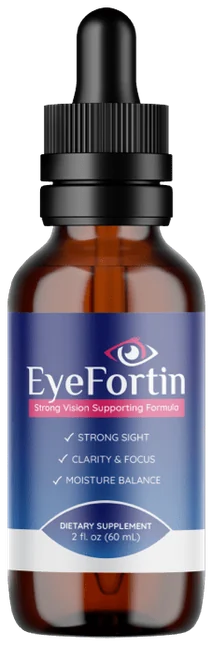
$69/ bottle
Total $99 $69
- One-time purchase
- Free US shipping
- 60-day refund window
Vendor pricing at time of review
Best value
6 bottles
180-day supply
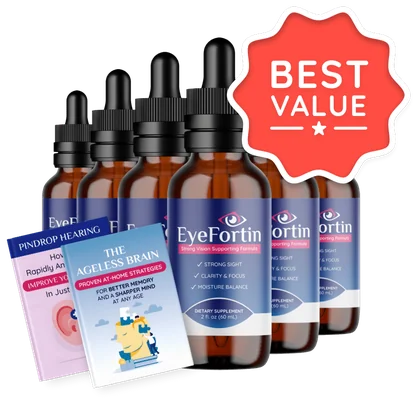
$49/ bottle
Total $594 $294
- Lowest cost per day
- 2 free eBooks
- Free US shipping
Vendor pricing at time of review
3 bottles
90-day supply
$59/ bottle
Total $297 $177
- Middle cost per day
- 2 free eBooks
- Free US shipping
Vendor pricing at time of review
Run the numbers as cost per day rather than cost per bottle. At $69 for 30 servings the single bottle is $2.30 a day; at $49 for 180 servings the six-pack is $1.63. Whether a $100+ commitment to an untested formula is reasonable depends on your budget and how much you value trying it, not on the discount’s size. International buyers add $15.95 shipping to Canada, the UK and Ireland, and Australia and New Zealand. Our price analysis has the full table including per-day maths and the bonus eBook valuations.
The EyeFortin 60-day guarantee
The vendor states a 60-day, 100% money-back guarantee with no return of the bottle required, and one-time purchase with no recurring billing. Those are good terms — better than most of this category, where auto-ship traps are common.
Two practical notes before you rely on it. The clock starts on the order date, not the delivery date, which matters for international buyers who lose two to three weeks to shipping. And refunds in this industry are usually processed by email request rather than a self-service portal, so you need your order number and a written request inside the window. Our guarantee page sets out exactly what to write, what to keep, and what to do if the first request goes unanswered. If you pay by credit card and the vendor does not respond, a chargeback is available, but it is a last resort.
Where to buy EyeFortin
Direct from the vendor’s own checkout is the only verified route. There is no confirmed Amazon listing, no Walmart listing, no pharmacy or health-food-store distribution. That single-channel model is common for direct-response supplements and it has one real advantage: fewer counterfeit or expired bottles in circulation.
It also has a disadvantage worth naming. Buying only from one seller means no price competition and no marketplace buyer protection. If you see EyeFortin on a marketplace, treat it as unverified unless the seller is the brand itself. Our retail availability page explains why third-party listings in this category are a risk, and our official website check walks through how to tell the vendor’s own page from the dozens of lookalike affiliate domains.
The ordering guide walks through the checkout, and the official page check covers how to verify you are on the vendor’s own domain before entering card details.
EyeFortin pros and cons
What we liked
- All ten active ingredients are named on the panel — no hidden proprietary “matrix” of unnamed botanicals
- The two vitamins carry exact doses and are easy to compare against dietary reference intakes
- An unusually candid label warning that safety has not been determined
- Written 60-day refund window with no bottle return
- No autoship, no subscription, no hidden recurring charge
- Free US shipping on every package, including the single bottle
- Liquid format suits people who cannot swallow capsules, and the dose is easy to adjust downward
What gave us pause
- Eight of ten ingredients are hidden inside one 500 mg blend, so no dose can be checked
- No published trial of the finished formula, and no third-party certificate of analysis
- The mechanism story (“rebuild glutamate receptors”) is inventively worded and not supported by product evidence
- Contains no lutein or zeaxanthin, the two best-studied eye nutrients
- Huperzine A brings genuine drug-interaction considerations for a supplement sold to “all ages”
- The “Greek morning ritual” and 107,100-customer framing are marketing devices, not facts a reader can verify
- One seller only, no marketplace price competition
Who should skip EyeFortin
Skip EyeFortin if you have a diagnosed eye condition, if you take prescription medication that affects acetylcholine, or if you want a proven carotenoid formula.
- Anyone with glaucoma, AMD, diabetic retinopathy or a cataract diagnosis. These need ophthalmology, and a supplement that feels like action can delay real treatment.
- People taking donepezil, rivastigmine, galantamine, or glaucoma medication. Huperzine A adds cholinergic load. Discuss it with the prescriber first — not instead.
- Pregnant or breastfeeding readers. There is no safety data for this formula in these groups, and the label says so.
- Anyone under 12, per the label.
- People expecting a glasses-free outcome. Refractive error is structural.
- Budget-constrained readers who want the best-evidenced option. A basic lutein–zeaxanthin supplement or a fish-oil capsule costs less per month and has more human trial data behind it.
Frequently asked questions
Frequently asked questionsIs EyeFortin a scam?
It is a real, physically shipped product with a label that matches the ingredient descriptions in its own marketing, a working support address, and a stated refund policy. That is a legitimate operating pattern. It is not, however, a proven treatment: no finished-product trial exists, and the mechanism claims go beyond what the evidence supports. “Legitimate business, unproven claims” is the fair summary.Does EyeFortin really work?
There is no way to answer that as stated, because “work” has not been defined in a trial. What the evidence supports: the vitamins correct a deficiency if you have one; taurine and the cholinergic ingredients are biologically plausible; and there is no mechanism by which the product would change refractive error or reverse eye disease. If your goal is less screen fatigue, breaks and lubricating drops have better evidence and cost less.Does EyeFortin contain lutein and zeaxanthin?
No. Neither appears on the current 60 mL label. Several popular articles about this product list them anyway; those articles are describing a different or imagined formula. The actual panel is two B vitamins plus a 500 mg blend of amino acids, choline, coleus forskohlii, eyebright and huperzine A.How long does EyeFortin take to work?
The vendor suggests consistent daily use, and the package sizes imply a one-to-six-month runway. Realistically, any felt change from the cholinergic ingredients would appear within days, while nutritional correction of a deficiency takes several weeks. Structural vision change is not on the table at any timeframe.Are there side effects?
Reported issues are mild and uncommon: digestive discomfort in the first days, occasional headache, and in sensitive people a niacinamide-related warm feeling. The label states that safety has not been determined. The ingredient most likely to cause a real problem is huperzine A, because of its effect on acetylcholine and its interaction with certain prescription drugs.Can I take EyeFortin with other supplements?
Usually yes, but watch the overlap. Adding another B-complex pushes total B6 higher, and adding a choline or huperzine product compounds the cholinergic effect. If you take a multivitamin plus a separate B-complex plus EyeFortin, you are stacking three sources of the same two vitamins.Is EyeFortin FDA approved?
No dietary supplement is FDA approved. The FDA does not approve supplements, it regulates their labelling and manufacturing. EyeFortin’s label carries the standard DSHEA disclaimer stating that these statements have not been evaluated by the FDA.Where is the cheapest place to buy EyeFortin?
The six-bottle package at $49 per bottle, direct from the vendor, is the lowest verified price at $1.63 a day. There is no confirmed marketplace or retail listing to compare against, so no third-party discount is available to check.What is the “Greek morning ritual” EyeFortin advertises?
A marketing narrative, not a documented practice. No peer-reviewed source describes a Greek ritual for eyesight, and nothing in the product connects to one. We fact-check the claim in full because it is the headline hook people search for.Is EyeFortin safe for seniors?
The label does not exclude older adults, but the interaction question matters more at 70 than at 30 — polypharmacy is common, and huperzine A interacts with several drug classes. Anyone with an existing eye condition should be under ophthalmological care regardless.
Is EyeFortin a scam?
Does EyeFortin really work?
Does EyeFortin contain lutein and zeaxanthin?
How long does EyeFortin take to work?
Are there side effects?
Can I take EyeFortin with other supplements?
Is EyeFortin FDA approved?
Where is the cheapest place to buy EyeFortin?
What is the “Greek morning ritual” EyeFortin advertises?
Is EyeFortin safe for seniors?
References
- Froger N, Moutsimilli L, Cadetti L, et al. Taurine: the comeback of a nutraceutical in the prevention of retinal degenerations. Progress in Retinal and Eye Research. 2014;41:44–63. Source
- Arfuzir NN, Agarwal R, Iezhitsa I, et al. Taurine protects against retinal and optic nerve damage induced by endothelin-1 in rats via antioxidant effects. Neural Regeneration Research. 2018;13(11):2014–2021. Source
- Jung KI, Kim YC, Park CK. Dietary niacin and open-angle glaucoma: the Korean National Health and Nutrition Examination Survey. Nutrients. 2018;10(4):387. Source
- Kamanna VS, Kashyap ML. Mechanism of action of niacin. American Journal of Cardiology. 2008;101(8A):20B–26B. Source
- Naber M, Hommel B, Colzato LS. Improved human visuomotor performance and pupil constriction after choline supplementation in a placebo-controlled double-blind study. Scientific Reports. 2015;5:13188. Source
- Neri DF, Wiegmann D, Stanny RR, et al. The effects of tyrosine on cognitive performance during extended wakefulness. Aviation, Space, and Environmental Medicine. 1995;66(4):313–319. Source
- Majeed M, Nagabhushanam K, Natarajan S, et al. Efficacy and safety of 1% forskolin eye drops in open angle glaucoma — an open label study. Saudi Journal of Ophthalmology. 2015;29(3):197–200. Source
- Bigagli E, Cinci L, D’Ambrosio M, et al. Pharmacological activities of an eye drop containing Matricaria chamomilla and Euphrasia officinalis extracts in UVB-induced oxidative stress and inflammation of human corneal cells. Journal of Photochemistry and Photobiology B. 2017;173:618–625. Source
- Yu P, Dong WP, Tang YB, et al. Huperzine A lowers intraocular pressure via the M3 mAChR and provides retinal neuroprotection via the M1 mAChR. Annals of Translational Medicine. 2021;9(4):332. Source
- Wang R, Tang XC. Neuroprotective effects of huperzine A: a natural cholinesterase inhibitor for the treatment of Alzheimer’s disease. Neurosignals. 2005;14(1–2):71–82. Source
- Sofi F, Marcucci R, Bolli P, et al. Low vitamin B6 and folic acid levels are associated with retinal vein occlusion independently of homocysteine levels. Atherosclerosis. 2008;198(1):223–227. Source
- Jackson CR, Ruan GX, Aseem F, et al. Retinal dopamine mediates multiple dimensions of light-adapted vision. Journal of Neuroscience. 2012;32(27):9359–9368. Source
- Zhao ZC, Zhou Y, Tan G, et al. Research progress about the effect and prevention of blue light on eyes. International Journal of Ophthalmology. 2018;11(12):1999–2003. Source
- Thoreson WB, Witkovsky P. Glutamate receptors and circuits in the vertebrate retina. Progress in Retinal and Eye Research. 1999;18(6):765–810. Source
- Age-Related Eye Disease Study 2 Research Group. Lutein + zeaxanthin and omega-3 fatty acids for age-related macular degeneration: the Age-Related Eye Disease Study 2 randomized clinical trial. JAMA. 2013;309(19):2005–2015. Source
- Age-Related Eye Disease Study Research Group. A randomized, placebo-controlled, clinical trial of high-dose supplementation with vitamins C and E, beta carotene, and zinc for age-related macular degeneration and vision loss: AREDS report no. 8. Archives of Ophthalmology. 2001;119(10):1417–1436. Source
- National Institutes of Health, Office of Dietary Supplements. Niacin — fact sheet for health professionals. Source
- National Institutes of Health, Office of Dietary Supplements. Vitamin B6 — fact sheet for health professionals. Source
- Topo E, Soricelli A, Di Maio A, et al. Evidence for the involvement of D-aspartic acid in learning and anxiety behaviors. Frontiers in Psychology. 2016;7:1915. Source
- U.S. Food and Drug Administration. Dietary Supplements: guidance and regulatory information (DSHEA). Source
- U.S. Food and Drug Administration. Dietary supplement labeling guide. Source
- National Eye Institute. Dry eye. Source
- National Eye Institute. Refractive errors. Source
Links open in a new tab. Citations are provided for ingredient and background research only. No published trial has tested the finished EyeFortin formula.
Final assessment: is EyeFortin worth it?
EyeFortin is a coherent supplement with a marketing problem, not the other way around. The formula has a defensible logic: B vitamins for nerve metabolism, taurine for retinal antioxidant defence, choline donors and huperzine A for cholinergic signalling. A formulator with an interest in retinal neurochemistry could have written that ingredient list honestly.
Then the marketing wrapped it in “rebuild your glutamate receptors”, a Greek ritual that does not exist, and a customer count nobody can audit. That is the pattern this whole category falls into, and it is why a careful buyer should discount the story by roughly the same amount they credit the label.
Our recommendation is conditional. If you are curious, have no diagnosed eye condition, take no interacting medication, and you want to spend $49–$69 to test a plausible formula for a month, the refund terms make that a low-risk experiment. If you want the highest probability of measurable benefit per dollar, spend it on a lutein–zeaxanthin supplement with the AREDS2 evidence behind it, a fish-oil capsule, and a proper eye examination — then come back to this product if you still want to try something different.
EyeFortin: current pricing and availability
The vendor’s page carries the live package prices, the refund terms and the shipping table. Prices in this review reflect what we saw when it was last checked.
View current package optionsOpens the vendor’s checkout page in a new tab. This site is independent and not the manufacturer.
This page was last reviewed on 27 October 2026. If the label, pricing or refund terms change, we update the page and note the change here. Spotted something out of date? Tell us.